Showing posts with label ocean. Show all posts

Wednesday

Human impact on sea urchin abundance

In the longest running study of its kind, researchers found sea urchin populations were strongly affected by human-driven environmental change

Date:
April 25, 2018
Source:
Kyoto University
Summary:
In a 50-year study, researchers record the dynamics of three common species of sea urchins in Hatakejima Island, Wakayama.

Arial view of Hatakejima Island, Wakayama, where the study took place over 50 years.
Credit: Kyoto University / Nakano Lab
Sea urchin populations are more sensitive to human activities than previously believed, according to a half-century observational study. Researchers found that changing water temperature and algal blooms strongly affected sea urchin populations and even caused some abnormal development of their larvae. The research is published in the journalEcological Indicators.

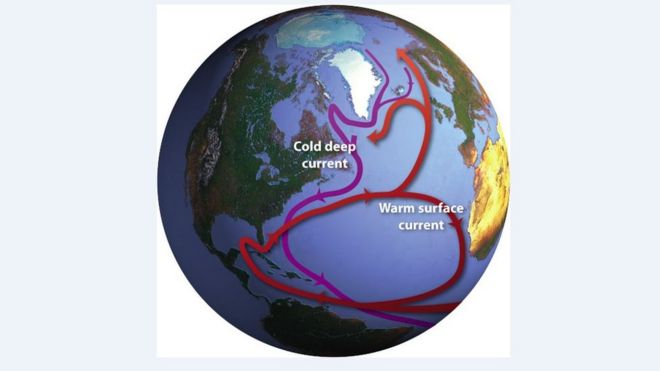
Climate change dials down Atlantic Ocean heating system


A significant shift in the system of ocean currents that helps keep parts of Europe warm could send temperatures in the UK lower, scientists have found.

Baby fish led astray by high CO2 in oceans


Date:
April 11, 2018
Source:
University of Adelaide
Summary:
Baby fish will find it harder to reach secure shelters in future acidified oceans -- putting fish populations at risk, new research has concluded.
Baby fish will find it harder to reach secure shelters in future acidified oceans -- putting fish populations at risk, new research from the University of Adelaide has concluded.

Tuesday

Fish have ears, so man-made noise threatens their survival


April 10, 2018, University of Exeter
Fish have ears, so man-made noise threatens their survival


The fishy problem of underwater noise pollution

April 10, 2018 by Adam Crane And Maud Ferrari
The fishy problem of underwater noise pollution
Boat noise can interfere with the underwater communication of fishes and other marine animals. Credit: Unsplash, CC BY-SA

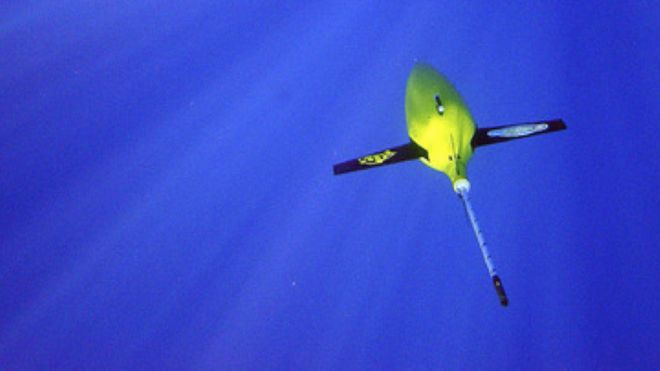
Silent robots listen to ocean winds

10 April 2018

New satellite method enables undersea estimates from space

Statistical advance quantifies important ocean parameters in the illuminated ocean

Date:
April 3, 2018
Source:
Bigelow Laboratory for Ocean Sciences
Summary:
Researchers have developed a statistical method to quantify six important ocean particles from satellite data.
Researchers aboard the RV Roger Revelle prepare a bottle to collect water from the deep ocean.
Credit: Rebecca Fowler

Thursday

Herring larvae could benefit from an acidifying ocean

A long-term field study in a Swedish fjord shows how rising carbon dioxide levels can affect food webs and fish survival

Date:
March 29, 2018
Source:
Norwegian University of Science and Technology
Summary:
Excess carbon dioxide in the atmosphere is making the oceans more acidic. Some studies show that's bad news for fish, including commercially important species. But a new study shows that herring might be able to tolerate this change.
These strange-looking floating objects are really giant plastic test tubes called KOSMOS mesocosms that extend roughly 19 metres deep. Researchers used them to test the response of young herring to ocean acidification.
Credit: KOSMOS/GEOMAR

Wednesday

Coral reef experiment shows: Acidification from carbon dioxide slows growth

Ocean acidification will severely impair coral reef growth before the end of the century if carbon dioxide emissions continue unchecked

Date:
March 14, 2018
Source:
Carnegie Institution for Science
Summary:
Ocean acidification will severely impair coral reef growth before the end of the century if carbon dioxide emissions continue unchecked. The paper represents the first ocean acidification experiment in which seawater was made artificially acidic by the addition of carbon dioxide and then allowed to flow across a natural coral reef community. The acidity of the seawater was increased to reflect end-of-century projections if carbon dioxide from greenhouse gas emissions are not abated.


This is an experimental plume of carbon dioxide-enriched seawater and a dye tracer flowing across a coral reef flat in Australia's Great Barrier Reef. This study represents the first ocean acidification experiment on a natural coral reef community and provides evidence that near-future ocean acidification projections severely depressed coral reef growth.
Credit: Photograph is courtesy of Aaron Takeo Ninokawa of UC Davis.

Friday

Tracking changes in fish communities


Date:
March 2, 2018
Source:
Kyoto University
Summary:
In a study spanning twelve years, researchers have developed a method to calculate the fluctuating stability of a natural ecological community in Maizuru Bay.